This is the fourth in a series of posts concerning which historic paint schemes, or “liveries,” should be applied to the double-ended “torpedo” PCC streetcars about to be restored by Muni. (They’ve asked Market Street Railway for input, as their non-profit preservation partner, but the final decision is theirs.)
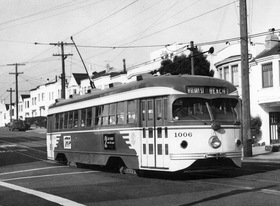
PCC No. 1006 in its original “Wings” livery in the early 1950s. Will Whittaker photo.
We’ve already looked at the possibility of liveries from other cities’ operations that once ran double-ended PCCs, such as Dallas, Texas, Boston, Massachusetts, and Pacific Electric of Southern California. Now it’s time to stay home and look at options in San Francisco.
Muni has already decided to paint at least one of the double-end PCCs being restored in a Muni livery. Car No. 1006 will wear its original 1948 green and cream paint scheme featuring “wings” (called fingers by some) of paint reaching back from the doors towards the center of the car. So will single-end PCC No. 1040, chosen for restoration in the same batch because it is the last of some 5,000 PCC streetcars built in North America between 1936 and 1952.
So there will be at least two additional PCCs in the Muni “Wings” livery that lasted (on some PCCs) right through to their “first” retirement in 1982. This could allow the future repainting of current F-line streetcar No. 1050, an ex-Philadelphia PCC, into a different livery, but that’s a subject for a separate post, so we’re going to talk only about the double-ended PCCs here.
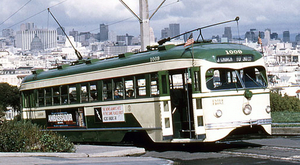
1009 displays Muni’s “simplified” paint scheme after being converted to single-end operation. Shown on the J-line at 20th Street in 1964. Walter Rice photo.
Muni’s “torpedoes,” as the ten big double-end cars numbered from 1006 to 1015 were called, were all converted to operate from one end only by the mid- to late-1950s. Since at that point they were always going in the same direction, it was no longer important to have a symmetrical livery (one that would look the same no matter which end of the car was going forward). So some, but not all, of the torpedoes received what Muni called its “simplified” green and cream paint scheme, so called because it took less time for painters to apply than did the “Wings.”
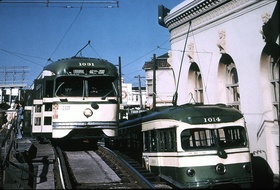
1014 (at right) shows how Muni’s simplified paint scheme looked on the rear of the torpedoes after they were changed to single-end operation. Walter Rice photo.
This simplified scheme is represented in the current F-line fleet by ex-Philadelphia single-end streetcar No. 1051, and could also be applied to one of the double-end cars being restored, although on a torpedo the car would appear to be going “backward” when operated from its number 2 end.
In the late 1970s, near the end of Muni’s first PCC era, a handful of streetcars got a cosmetic refurbishment, which included the new “Landor” paint scheme created pro bono for Muni by famed San Francisco industrial designer Walter Landor. (This included the first use of Muni’s current wiggly logo, aka “the Worm.”) None of the torpedoes got this design in revenue service; however, No. 1008, one of the cars up for restoration, got a home-brew Muni version of it when it was converted into what its lettering described as a “repair car.” It is possible that a Landor livery could be applied to one of the cars.
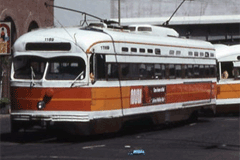
Landor livery was applied to a handful of Muni’s PCC fleet, although not to any of the torpedoes. Jack Garcia photo, Peter Ehrlich collection through nycsubway.org.
Then there are the “fantasy liveries” that some railfans love to discuss. Muni itself actually brought one to life when the first group of torpedoes rejoined the active fleet in the mid-1990s.
At the insistence of a Muni manager (now retired), double-end car No.1007 originally operated in the same livery applied to Muni’s current Breda LRVs. It was very unpopular in part because it was deemed not historic, and was subsequently changed to honor Philadelphia’s Red Arrow line, which ran very similar double-end PCCs.
Yet it could be said that the current Muni gray and red livery is really just a modernized version of Muni’s very first streetcar livery, represented by 1912 Car No. 1. If Muni had acquired its first streamliner streetcars a year earlier than they did, they probably would have been painted like car No. 1. (As it was, the five streamliners Muni received in 1939 were the first to be painted blue and gold in honor of that year’s Treasure Island World’s Fair. F-line double-ender No. 1010 wears this livery today.) A possibility one of the torpedoes could be that original gray Muni livery, with red roofs and “Municipal Railway” in gold lettering above the windows.
And then there’s the ultimate San Francisco “what-if,” one we’ve heard suggested to us over and over by long-time San Franciscans.
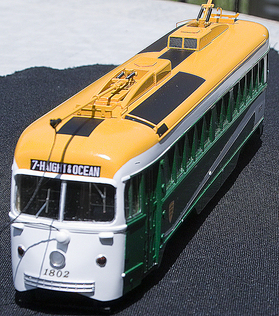
Market Street Railway’s patented “White Front” livery with zip stripe on the sides on a model. Walter Rice photo.
Our namesake, Market Street Railway, made drawings of a PCC-type double-end streetcar in the late 1930s, resplendent in the company’s patented “White Front” livery (totally white ends for visibility in the fog) with a bright yellow roof and green sides with a racy “zip stripe” slashing across the sides.
Many of its old fashioned streetcars were repainted in this livery around this time in an attempt to make them look, well, less boxy. Market Street Railway never ordered any PCCs, but the idea retained its fascination for decades, so much so that a model company offered a detailed version of this “what-if” livery.
So, there are a number of choices for painting additional torpedoes (beyond No. 1006) in liveries that offer a tribute to bygone San Francisco days and dreams. More “Wings” liveries, duplicating No. 1006 (and No. 1040 as well as — for now at least — No. 1050), the “simplified” green and cream Muni logo some torpedoes wore in the 1960s and 1970s, the Landor livery worn by some Muni PCCs (but not torpedoes) in the late 1970s, or fantasy liveries such as an original Muni gray and red car or a Market Street Railway “White Front” PCC.
Lots of choices to consider in your comments, which you can post below.
Part 1: Dallas, Texas
Part 2: Boston, Massachusetts
Part 3: Pacific Electric
Part 4: San Francisco
Part 5: Something Completely Different

Comments are closed.