In our last post, we looked back on the last days of streetcar service on the B-Geary line. In this post — an updated version of a story that appeared in the Summer 2002 issue of our member newsletter, Inside Track — we take a broader look back at the demise of streetcars in San Francisco in general, including the original F-line.
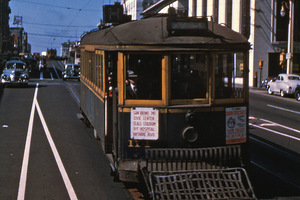 Van Ness Avenue hosted Muni streetcars until 1950. Bob McVay photo, Walter Rice collection.
It was all a plot. Fiendish bus builders, tire makers, fuel providers forming an illegal conspiracy to rob America of its beloved streetcars after World War II. That’s why we have so few lines left in San Francisco.
At least that’s what some streetcar fans fervently believe … with some reason. In that time period, so-called ‘rubber tire interests’ did indeed form a company called National City Lines that went around the country buying up private streetcar companies and converting them to bus operation. The buses, tires, and fuel usually came from the companies that owned National City. One such property, in fact, was the East Bay’s Key System. But even at the national level, this conspiracy theory leaves out lots of realities: private transit operators scratching to break even, with no capital to replace worn-out streetcars and track; the baby boom, spurring the development of suburbs well beyond the reach of existing streetcar lines; and the flat-out preference of most who could afford it for the automobile, especially after the sacrifices made during the war.
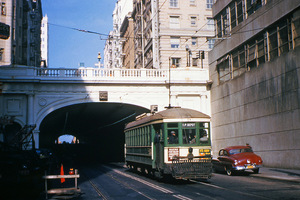 The original F-line. The Stockton Tunnel was built in 1914 as part of Muni’s original F-line, which ran until 1951. Here, car No. 9 is headed for Chinatown and North Beach shortly before the 30-Stockton trolley bus took over this route. Bob McVay photo, Walter Rice collection.
Some of these national factors did impact Bay Area transit. Other factors that shaped San Francisco’s streetcar story were unique.
San Francisco’s two major transit systems merged in 1944, when, after numerous failed attempts, voters finally approved a bond issue to allow publicly owned Muni to buy out the larger, private Market Street Railway Company (MSRy). The strains of heavy wartime demand were apparent on the cars and tracks of both systems, especially MSRy, which had endured hard financial times well before the war and was not making any significant capital investments in its infrastructure.
As the war neared its end, the city’s transit system was falling apart. Muni owned only five modern streetcars, bought in 1939, out of a combined fleet of almost 500. Most of those cars were completely worn out, as was much of the track and overhead wire they ran on.
The Newton Plan
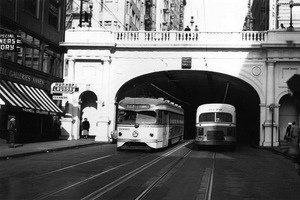 Muni’s ‘torpedoes’ never were assigned to regular service on lines where modern equipment might have helped preserve streetcar service, but they did run some routes as charters, giving a taste of ‘what might have been’. Market Street Railway Director Walt Vielbaum went along on some of these special charters, and took this great shot. Here, car No. 1006 leaves the Stockton Tunnel on the last day of streetcar operation on the F. Note the outbound White 798 gasoline bus with the ‘F’ designation in the rear window. Walt Vielbaum photo.
Muni management knew it needed to modernize once the war ended, so in early 1945, it commissioned a plan for postwar operation from consulting engineer Leonard Newton, a former vice president of MSRy. He understood the poor condition of the cars and track and recommended converting more than half the existing streetcar lines to trolley coach or motor coach operation, including the J-Church and M-Ocean View. However, he did advocate retaining thirteen streetcar routes and reequipping them with modern ‘PCC’ type streamline streetcars (as now run on the F-line). These included eight Muni lines: the B, C, and D, which used Geary; the K, L, and N, which all used tunnels too small for buses; the F-Stockton and the H-Van Ness. Also included were five ex-MSRy lines: 3-Jackson, 4-Sutter, 7-Haight (rerouted via the Sunset Tunnel), 14-Mission, and the inner section of the 17 Haight-Parkside line. All in all, Newton recommended buying 313 new PCC streetcars, which would have been a huge order.
However, while Newton’s report laid out the costs of buying the new vehicles and reconstructing the track, it did not include operating costs, a critical omission. As he predicted in his plan, the end of gasoline rationing sent many Muni riders back to their automobiles again. Even with a fare increase, Muni’s finances were rapidly deteriorating at a time when transit systems were still expected to make a profit.
Two-person crews
San Francisco required crews of two on streetcars and cable cars, though only one on buses. With the merger, Muni now had two powerful operator’s unions to deal with: its own, and the one that still represented ex-MSRy motormen and conductors. Both unions were staunchly opposed to reducing crew size, which would have required a City Charter amendment approved by the voters in any event. So Newton repeatedly stated in his report that the new PCCs would be modified for operation by two-person crews, even though a major reason the transit industry designed the PCC in the first place, some ten years earlier, was to cut labor costs in half by only requiring a single operator per car.
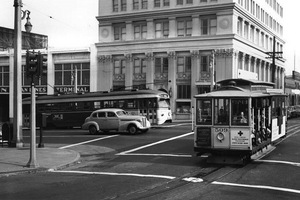 Here’s No. 1006 on the H-line, inbound on Van Ness Avenue at Jackson. Washington-Jackson cable car No. 509 is headed toward Pacific Heights, a wonderful line destroyed in the mid-1950s when the cable system was severely cut back. Walt Vielbaum photo.
Two years after Newton’s plan came out, the City worked up another plan in conjunction with a $20 million bond issue to modernize Muni. By this time, the proposed vehicle mix had tilted sharply toward buses. The labor cost differential clearly played a major part. The bond issue passed, but the money was almost all spent on hundreds of new trolley coaches and motor coaches used to convert former streetcar lines. Had there been enough money right after the war to buy a full fleet of PCC cars, at least for the core streetcar lines, the public might have embraced their comfort and speed and insisted on retention of more streetcar lines. However, with two-man PCC streetcars costing double the operating cost of a one-driver bus of similar capacity, there was no management incentive to buy large numbers of new streetcars.
What the public saw instead at the end of the 1940s was a fleet of new trolley coaches and motor coaches with upholstered seats and effective heaters running on smoothly repaved streets, replacing noisy, drafty, old streetcars with hard seats often bouncing along on bad track.
A few new streetcars
Muni did manage to find enough money from another source to buy ten modern streetcars, its first true PCCs, in 1948. These cars, numbered 1006-1015, were double-ended and set up for two-person crews. (Three of these, fully restored, are in F-line operation today; four more are slated for restoration by 2011.)
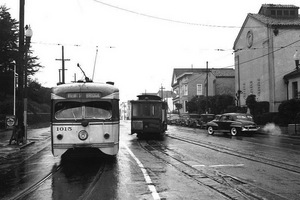 This shot, from a 1948 charter, shows car No. 1015 headed downtown on the former MSRy 1-line on California Street at Presidio Avenue, about to jog over to Sutter. It’s passing a California Street Cable Railway car changing ends opposite the Jewish Community Center. There had been talk early of saving two Sutter lines, the 3 and 4, as streetcars, but the 1-line was always slated for bus conversion. Walt Vielbaum photo.
Added to the five 1939 ‘Magic Carpet’ cars, which were almost identical in appearance, Muni now had fifteen modern cars. Had they been deployed strategically on a line where it was not final whether streetcars would stay or go, they might have made a difference. Instead, however, in that critical period from 1948-1951, the modern cars were concentrated on two tunnel lines, the L and the N, neither of which was in danger of conversion.
Some elements of the Newton plan had by this time been put into effect. The F-Stockton line (today’s 30-line trolley bus), which ran from the Marina through North Beach and Chinatown, reaching downtown through the Stockton tunnel, was connected to old MSRy tracks at Fourth & Market to reach the Southern Pacific train depot, then at Third & Townsend Streets. The H-Van Ness line — which ran from Fort Mason south on Van Ness, 11th Street and Potrero Avenue to Army Street — was tied in there to the old MSRy 25-line on San Bruno Avenue to reach almost to Visitacion Valley.
Streetcars slip away on the F and H
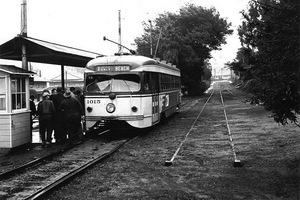 Here’s PCC No. 1015 at the rustic terminal of the D and E lines inside the Presidio. Early postwar plans called for Union Street to be dual-mode. The E-line streetcars had been slated for conversion to trolley bus even before the war, but Muni couldn’t get the vehicles. But the D-line, which shared Union with the E, then followed Van Ness and Geary downtown, was recommended in the Newton plan to stay a streetcar operation. Trolley buses and streetcars shared Union for a short time until the D became the 45-line bus. Walt Vielbaum photo.
In the various plans coming forth right after the war, the F and H lines were generally marked for retention; thus the investment in the extensions. But most of the original H-line route, on Van Ness and Potrero, was also US 101, and the State Division of Highways had a big say in what happened on those streets. With plans being made for heavy residential development in Marin County, across the Golden Gate Bridge, it seemed certain that automobile demands on Van Ness would increase rapidly. Some grumbled that streetcars stopping frequently in the ‘fast lane’ of the broad street would hold up automobiles. Running the modern streetcars on Van Ness might have counteracted this pressure somewhat, but there was resistance in Muni to using its newest cars on the beat up track on the ex-MSRy route south of Army Street.
The F-Stockton posed a different problem. Muni’s new streetcars were wide, but the F-line used Muni’s oldest ‘A-type’ cars because they were also its narrowest, and could more easily squeeze past the delivery trucks on the commercial streets that made up most of the route. Trolley coaches, not stuck on rails, could at least swing around traffic that got in their way, and on Stockton Street, especially in Chinatown, that came to be seen as an appealing alternative, especially when F-line riders were still using 1912-vintage streetcars.
Streetcars saved on the J and M
Muni had enough trolley coaches to convert the F-Stockton because it had been foiled in its plans to create the 46-Church trolley coach line. The J-line streetcar ran (and still runs) on a scenic private right-of-way to negotiate steep Dolores Heights, but it didn’t have any tunnels such as were protecting other lines’ streetcars. J-line ridership was lower than either the F or H and trolley coaches could easily handle the grades involved. But J-line riders in Noe Valley — and politicians who lived nearby — raised a fuss, and the streetcars were saved, making the replacement trolley coaches available for other conversions.
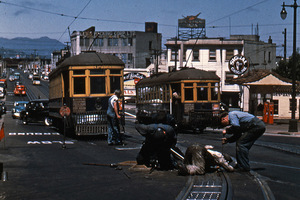 North Beach in 1947, before the tourists. Muni workers are repairing the cable car curve at Mason & Columbus. Soon afterwards, in 1951, the F‑Stockton streetcar line disappeared from this scene, despite efforts to save it. Here, F-line car No. 32 is held up by the repairs, since the streetcars and cable cars shared unusual dual-gauge trackage for two blocks on Columbus. That’s a Powell-Mason cable in the distance about to turn onto Taylor, with Mt. Tamalpais in the background. After the streetcar tracks were removed, you could still see remnants of the crossing points and feel a slight extra thump when you crossed the spot on a cable car. But that last memory vanished in 1983, when the cable car tracks were ripped out and completely rebuilt … in the curb lanes of Columbus Avenue, not the center lanes where they traditionally ran. Bob McVay photo, Walter Rice collection.
Surprisingly to many riders today, the M-Ocean View was slated for bus conversion as well. Built in 1925, it ran through wide-open spaces on 19th Avenue that proved slower than expected to develop. But right after the war, the development of the Parkmerced apartment complex next to the M-line made planners think twice about dumping it. So did a 1948 plan by engineering firm DeLeuw Cather that recommended the M-line right-of-way as a rapid transit line (a proposal made again in conjunction with BART in the 1960s). The stunning aspect of that plan, however, was a grid of freeways beyond even what the State later proposed (and which caused the historic ‘freeway revolt’ of the late 1950s and 1960s. The car was queen in this plan … surface transit the ugly stepchild.
Looking back, there were many factors combining to truncate San Francisco’s streetcar system after World War II. But the requirement for two crew members, even on modern streetcars, clearly played a dominant role. In a 1949 report on the Muni to the Board of Supervisors, consulting engineer Arthur Jenkins noted, “Almost every city in the country that still continues to operate streetcar service uses one-man cars with the notable exception of San Francisco.” He went on to state, “It has been generally true throughout the industry that use of one-man cars has not been adopted primarily as a means of increasing profits to owners, but as a means of remaining in business at all.”

Comments are closed.