streetcar.org - market street railway - projects and priorities
Click on the map above to view Market Street Railway's vision for the E-line, highlighting historic and popular attractions along the line.
The southern E-line terminal could use this new loop at 18th and 19th Streets, now being built as part of the Third Street light rail project. This southern extension would serve the new Mission Bay community, historic Pier 70 and Dogpatch, and new residential developments such as these lofts at Third and 18th Streets.
The new Third Street light rail platforms in Mission Bay have a low-level area suitable for front-door loading of historic E-line cars, and can easily be extended to full-car length. The high-level LRV platforms can be used to load wheelchairs. That’s the Giants’ SBC Park in the background.
The E-line platforms on the southern Embarcadero are now completed, allowing low-level and wheelchair access to the historic fleet, while the LRVs use the high center platform to the left. This view looks north from Harrison Street at the Hills Plaza station.
Thanks to advocacy years ago by Market Street Railway, Delancey Street Foundation, and others, the E-line connector track is already in place between the Muni Metro light rail line on the southern Embarcadero and the F-line tracks from the Ferry Building north. Looking south from Howard Street, the E-line tracks flank the Muni Metro subway portal. That's the northbound E-line track to the left, with an N-Judah train entering the subway. The new Gap headquarters is on the right, with the mixed-use Hills Plaza complex in the background.
One of the possible E-line alignments under consideration would have historic streetcars running along the waterline at Aquatic Park and Municipal Pier.
Streetcars would use the single-track, historic 1914 Fort Mason Tunnel in both directions by observing safety signals, as is commonly done on railroads worldwide.
If streetcars used the right-of-way on the historic Aquatic Park promenade, they'd share it with pedestrians and cyclists, operating at about five miles per hour. Another option—avoiding the promenade—would be to put tracks in both directions on Beach Street, one block south.
Vision for the E-line
Imagine a string of pearls illuminating one of the greatest waterfronts in the world. Each pearl is a world-class destination: culinary, cultural, historical, recreational. Now, imagine that the string is a destination in itself—attractive vintage vehicles from around the world, each with its own rich history, each representing a great maritime city or country. That string of pearls is Market Street Railway’s vision for the forthcoming E-Embarcadero historic streetcar line.

The idea of the E-line is decades old. But a comprehensive vision for the line is especially timely now, in the wake of the passage of Regional Measure 2 by voters in seven Bay Area counties on March 2, 2004. This measure raises tolls on state-owned bridges in the region by one dollar to fund a variety of improvements in trans-bay transportation corridors. Among these improvements is a vast expansion of the bay ferry system. The E-line, which itself is earmarked for $10 million from the measure, would serve as a primary landside distributor of ferry passengers.

But the E-line is much more than that. Built out to the ultimate vision described here, the E-line would combine that regional transit connectivity with visitor promotion, recreational access, environmental improvement, and historic preservation. In these trying economic times for San Francisco, it would also serve as an effective driver of increased economic activity along the entire route.

Historic venues served by MSR's vision for the E-line

Presidio Main Post
Crissy Field
Palace of Fine Arts
Fort Mason
Municipal Pier
Ghirardelli Square
Aquatic Park
Maritime Museum
Hyde Street Pier
Haslett Warehouse
Argonaut Hotel
Fisherman's Wharf
Coit Tower
Filbert Steps
Jackson Square
Ferry Building
Agriculture Building
Rincon Annex
Bay Bridge
South Beach Warehouses
China Basin
Pier 70 Complex
Dogpatch

Riding history to see history
As envisioned by Market Street Railway, the E-line would leverage more than $200 million in rail infrastructure investment that San Francisco has already made, by sharing tracks with the wildly popular F-line historic streetcar service from Fisherman’s Wharf to the Ferry, with Muni Metro tracks from Hills Plaza to Caltrain, and with the northern portion (Caltrain to 19th Street) of the new Third Street light rail tracks now being built. From the Wharf west, new tracks would reestablish a historic rail right-of-way, opening an important new transit corridor along the city’s northern edge, connecting Aquatic Park, Fort Mason, the Marina, and the Presidio with other waterfront destinations.

The E-line would be unmatched by any other transit line in America in terms of the number of National Park units, National Historic Landmarks, National Historic Districts and National Register Properties it would serve. Most of these landmarks relate to San Francisco’s maritime history, which has enriched the city for more than 150 years, through interaction with other great port cities and maritime nations.

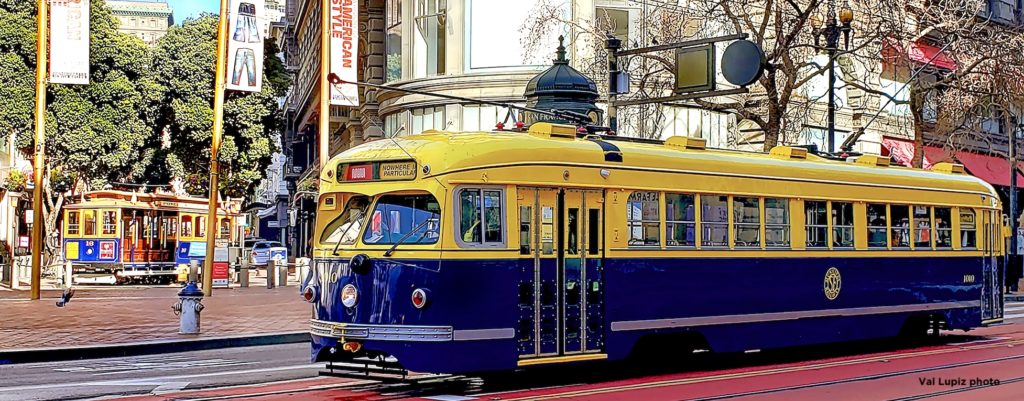
Market Street Railway’s vision for the E-line reinforces this legacy by proposing to primarily operate the line—at least during visitor season—with the most venerable streetcars in Muni’s historic fleet, which hail from such great port cities as Hamburg, New Orleans, Porto (Portugal), Melbourne, Osaka and Kobe/Hiroshima, and maritime nations such as Italy, England, and Russia. The streamlined PCC cars used on the F-line could also be used on the E-line, of course, but focusing on the historic equipment emphasizes the maritime heritage of the entire route alignment, and Market Street Railway would install displays on the E-line cars to educate riders about that heritage. Flags showing the cars’ origin and possibly appropriate maritime banners could further enhance the theme.

Past, present, future attractions
Market Street Railway envisions an E-line that links virtually every historic maritime site along San Francisco’s bay frontage, along with dozens of current and planned destinations, illustrated here.

At the southern end, one option is to terminate the E-line near Pier 70, using a track loop already under construction on 18th, 19th, and Illinois Streets as part of the new Third Street light rail project. The Pier 70 complex, built between 1886 and 1917 by Union Iron Works (later Bethlehem Steel) was recently described by the environmental group San Francisco Tomorrow as “the oldest, most intact collection of industrial buildings in the City,” and has been under serious consideration as a National Historic District. Active dry dock operations still occupy part of the site, but many of the fabulous masonry structures are vacant, and—when seismically upgraded—could be reused in a variety of productive ways. Recent news reports indicate that the highly-popular children’s science facility, the Exploratorium, may move here from the Palace of Fine Arts. Of note: Muni’s K-type streetcars (Nos. 169-188) were built at Pier 70 by Bethlehem Steel in 1923.

The E-line terminal would be within walking distance of Dogpatch, the oldest, most intact concentration of Victorian-era workers’ housing in the City, and one of only eight city-designated historic districts (the E-line would serve four of them).

From this historic neighborhood, the E-line would share tracks and stops through San Francisco’s newest neighborhood—Mission Bay—and its UCSF campus to reach th

e Caltrain Depot at Fourth and King Streets. Short, low-level platforms are already in place on this section of Third Street, sufficient for front door loading of historic streetcars (photo at left).

From Caltrain, the line would serve the Giants’ ballpark, the forthcoming James R. Herman Cruise Ship Terminal at Piers 30-32, and many recent and proposed high-density residential developments in the South Beach and Rincon Hill areas. Recently completed low-level boarding platforms at four Muni Metro stations from Caltrain to Hills Plaza let historic streetcars share the stations with Breda light rail vehicles from the N-Judah and future Third Street lines (photo at left). Thanks to advocacy efforts by Market Street Railway and such allies as Delancey Street Foundation, exclusive E-line tracks and wires are already in place between Folsom Street, where LRVs enter the Market Street subway, and the F-line tracks at Don Chee Way, between Mission and the Ferry Building. Market Street Railway envisions adding an E-line stop at Howard Street, since the Hills Plaza E-line stop is at Harrison, four long blocks from the Ferry.

Maritime history on board

To further emphasize the maritime theme of the E-line, Market Street Railway envisions partnering with the National Park Service, support groups such as the San Francisco Maritime Historic Park Association, companies such as Matson Navigation, and labor organizations such as the International Longshore and Warehouse Union (ILWU) to mount displays in the E-line streetcars interpreting the history of San Francisco's waterfront. These would both reflect and augment the marvelous kiosks installed along The Embarcadero's sidewalks as part of that boulevard's reconstruction.

Streetcars from foreign port cities would also interpret that city's maritime history, in relation to San Francisco's where pertinent. The cars would regularly fly their home flags, and perhaps marine signal flags on special occasions as well.

Reinforcing the F
The Ferry Building itself, of course, is now a vibrant destination again, following its reincarnation as a fine food marketplace. North of the Ferry Building, the E and F lines share the Embarcadero tracks to serve increased ridership generated by new developments now in the pipeline. These include the renovation of Piers 1-1/2, 3, and 5, now underway, and the big recreational facility proposed for Piers 27-31. The Mills Corporation, selected for the latter development, estimates it will generate 5,000 additional daily streetcar passengers along The Embarcadero—fully 25 percent of the current total F-line ridership. This estimate shows how much new waterfront developments are driving up demand for attractive transit like the E-line.

The E-line completes a continuous transit presence along The Embarcadero, to give transit riders the same options as motorists, bicyclists, and pedestrians along the waterfront strand. (F-line operators often hear disappointment—or worse—from intending riders at Fisherman’s Wharf when they learn they can’t take a historic streetcar all the way to the Giants’ ballpark, but must instead go a block up Market, get off the F car, go down into the subway, and wait for a train to bring them back to the Embarcadero surface, just three blocks south, in order to complete their trip.) Thus, the E-line should significantly increase commerce in the corridor, especially in conjunction with events like Giants’ ball games, cruise ship visits, and so on.

Westward ho!
On the northern edge of San Francisco, the E-line will open a beautiful new transit corridor to San Franciscans and visitors. Market Street Railway envisions it extending westward from the current F-line terminal at Jones and Jefferson to serve the new visitor center for San Francisco Maritime Historic Park in the historic Haslett Warehouse (now transformed into the nautically-themed Argonaut hotel), as well as the park’s Hyde Street Pier and its historic ship collection right across the street. The E-line would also serve the historic Maritime Museum building, Ghirardelli Square, and Municipal Pier at the foot of Van Ness before plunging into the historic 1914 railroad tunnel, reserved twenty years ago by the National Park Service for future rail transit.

Four blocks west, the E-line would emerge from the tunnel at Fort Mason Center, now a vibrant non-profit center with theatres, galleries, and frequent exhibitions. A loop would be built here, both for interim service until further extensions are built, and for special weekend exhibition service, to help reduce the automobile traffic that overflows the neighborhood.

West of Fort Mason, historic freight rails, now controlled by the National Park Service, extend alongside Marina Boulevard and into the Presidio. The E-line could either follow this 90-year old alignment, or another, to reach the Palace of Fine Arts, the Crissy Field Environmental Center with its beautifully restored tidal marsh, and the proposed Presidio transit center. The transit center will be centrally located between the historic Main Post and the vibrant Letterman Digital Arts Center, a major new employment center in San Francisco now under construction by filmmaker George Lucas at the old hospital site. From the transit center, a planned shuttle bus service would distribute E-line passengers to other destinations in the Presidio.

From vision to reality
Thanks to Market Street Railway and other advocates, this vision is moving closer to reality. With backing from Fort Mason Center, the Golden Gate National Parks Conservancy, the Presidio Trust, the Fisherman’s Wharf Merchants Association, and Market Street Railway, Rep. Nancy Pelosi earmarked funding for a technical feasibility study of possible routings between Fisherman’s Wharf and the Presidio, using the National Park Service-designated Fort Mason Tunnel as part of the route. A separate seismic study of the tunnel is also under way.

There’s little question that, at least, the initial phase of the E-line from Caltrain to Fisherman’s Wharf will come to pass, since its projected operation was key to the City’s approval of both the cruise ship terminal and Pier 27 recreational projects, and as mentioned $10 million of capital, intended for E-line streetcar renovation, is included in Regional Measure 2, passed on March 2, 2004. Momentum for the extensions is also building, with the city’s sales tax renewal, passed in November, specifically including $4 million for a westward E-line extension to Fort Mason, which is expected to leverage National Park transportation funding.

So, while it is currently unclear how long it will take to realize Market Street Railway’s vision for the E-line, the growing levels of community and political support—and funding—make it clear that the E-line remains on track.

This story originaly ran in Market Street Railway's quarterly newsletter, Inside Track. We hold web publication of such stories under a three-month embargo. To receive these stories in their printed form at their time of publication, join Market Street Railway today.
© 2007 Market Street Railway homelinkscontact infoabout this website