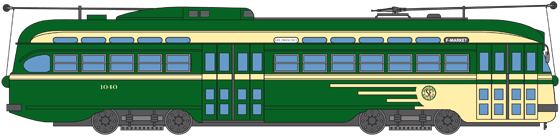
This is a special streetcar in several ways. No. 1040 is the very last of almost 5,000 PCC streetcars manufactured in North America. It was delivered to Muni in 1952, completing an order of 25 PCCs from the venerable St. Louis Car Company. Of all the single-end PCCs in Muni’s current active fleet, it is the only one that has worked in San Francisco its entire life.
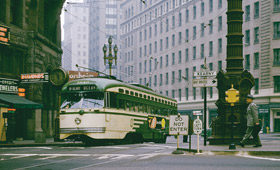 PCC 1040 on B-Geary at Lotta’s Fountain, one day after B-line service ended. Clark Frazier photo.
In 1944, the publicly owned Municipal Railway had acquired its private competitor, Market Street Railway Co., but the combined streetcar system was worn out. By 1951, 24 streetcar lines had been converted to bus operation, and only seven remained (the B and C on Geary and the J, K, L, M, and N branching off Market). Even so, Muni needed new streetcars to help replace the remaining ‘Iron Monsters,’ such as preserved cars Nos. 130 and 162.
By 1948, Muni owned 15 modern double-end streetcars (including the “Big Tens,” Nos. 1006-1015, all but two of which have been preserved), and was in the market for more. It wanted double-ended cars in this order as well. But with business waning, car builders were not interested in customization, and turned down Muni’s request for both double-end cars and single-enders with doors at both ends. Instead, Muni settled for St. Louis Car Company’s standard widebody design with front and center doors and oval standee windows, thought by many to be the handsomest of the PCC variations.
While still spacious with their nine-foot width, this class of Muni streetcars was four feet shorter than the “Big Tens,” so naturally they were dubbed the “Baby Tens” by motormen of the day. Because San Francisco voters had repeatedly refused to repeal the city ordinance requiring a two-person crew on streetcars, this class of cars was delivered with an odd single seat facing inward, opposite the center doors. This was the conductor’s station. Passengers entered at the rear, as on the old Muni streetcars, and paid their fare in a farebox mounted on a stanchion near the conductor. In 1954, though, voters changed their minds and allowed modern cars to operate “one-man.” This changed boarding and the farebox to the front of the car, but the conductor’s seat was never removed, and has been preserved in No. 1040’s restoration.
No. 1040 saw brief service on the B-Geary line after being delivered, but ran the rest of its first career on the J, K, L, M, and N lines, making tens of thousands of trips up and down Market Street and through city neighborhoods. Always recognized as special for its status as the “last PCC,” Muni took extra care with No. 1040, installing Bochum resilient wheels for a better ride and refurbishing the car with tan upholstery and the white, orange, and golden yellow “Landor” livery in the 1970s.
When Muni bought modern light rail vehicles and put its streetcar lines in a new subway under Market Street in the early 1980s, it looked like No. 1040 was out of a job. But it went back to work as part of the “Trolley Festival” summer fleet in 1983, proving the concept of vintage streetcar service that became the permanent F-line. It was repainted into a version of its original livery after the first Trolley Festival and ran four more summers on Market Street before being set aside for eventual full restoration.
No. 1040 has now been returned to like-new condition, preserving as many original features as possible—including that conductor’s seat.
The first streetcar of this class, No. 1016, has been beautifully and faithfully restored by the Bay Area Electric Railway Association at its Western Railway Museum, 55 miles northeast of San Francisco in Solano County. Nine additional cars of this class are stored by Muni, including four repurchased by Market Street Railway and donated back to their original owner, for possible future restoration.
 Originally built for
San Francisco Municipal Railway, San Francisco CA, 1952
Builder
St. Louis Car Co.
Restored
2010-11
Contractor
Brookville Equipment Company, Pennsylvania
Seats
58
Weight
37,600 lbs.
Length
46′ 5″
Width
9′ 0″
Height
10′ 3″
Motors
4 Westinghouse 1432K (55 hp each)
Control
Westinghouse PA
Trucks
St. Louis B-3
Brakes
Westinghouse Electric
